
Introduction
Choosing a flow controller throttle is not just a component decision; it directly affects process stability, actuator speed, pressure control, and overall system efficiency in pneumatic and hydraulic applications. For B2B buyers, the challenge is matching technical performance with installation constraints, control architecture, and total cost of ownership. This guide explains the key selection factors—from flow behavior and pressure conditions to material compatibility and integration requirements—so you can compare options with confidence, reduce procurement risk, and specify a throttle that supports reliable, repeatable operation in demanding industrial environments.
Why Flow Controller Throttle Selection Matters
In modern industrial automation, precise fluid and gas management dictates overall system efficiency, making the specification of a Flow Controller Throttle a critical engineering and procurement decision. These components act as the primary regulatory mechanisms within pneumatic and hydraulic circuits, controlling the speed of cylinder actuation, the volume of media delivered, and the stabilization of dynamic pressures. For B2B buyers, understanding the nuanced operational parameters of these throttles is essential to preventing downstream bottlenecks.
Selecting the appropriate throttle architecture requires balancing thermodynamic principles with commercial viability. Engineers must evaluate flow coefficients alongside the physical constraints of the installation environment. When procured correctly, these devices ensure seamless integration into existing Programmable Logic Controller (PLC) networks or manual control frameworks, driving long-term operational reliability.
Impact on process stability and yield
The primary function of any flow controller is to maintain rigorous process stability under fluctuating upstream pressures. In high-precision environments, such as semiconductor manufacturing or pharmaceutical dosing, even a minor deviation from the established flow setpoint can compromise the integrity of an entire batch. Industrial throttles are typically expected to maintain volumetric accuracy within a +/- 1% to +/- 2% margin. When flow rates drift beyond these parameters, the resulting inconsistencies can lead to uneven chemical mixing, improper thermal regulation, or erratic mechanical actuation.
Process yield is directly tethered to this stability. For instance, in automated pneumatic assembly lines, inconsistent throttle response times can cause actuator desynchronization, resulting in a 15-20% increase in product rejection rates. By specifying a throttle with a linear flow characteristic and minimal hysteresis, facilities can guarantee repeatable cycle times, thereby maximizing throughput and minimizing material waste.
Commercial risks of poor selection
Beyond immediate technical failures, the commercial risks associated with suboptimal throttle selection are substantial. Continuous processing plants measure downtime in thousands of dollars per hour; a catastrophic failure of a flow controller due to cavitation, seal degradation, or mechanical fatigue can halt production lines entirely. If a throttle is undersized, it may necessitate excessive pump energy to overcome pressure drops, driving up utility costs by as much as 10-15% annually.
Furthermore, specifying an over-engineered or incompatible throttle introduces unnecessary capital expenditure and elevated maintenance overhead. Poorly selected materials can lead to aggressive media corroding the valve internals, forcing premature replacements. Procurement teams must therefore assess the Total Cost of Ownership (TCO), factoring in the initial purchase price, anticipated mean time between maintenance intervals, and the potential revenue loss associated with unplanned system outages.
Technical Criteria for Specifying a Flow Controller Throttle
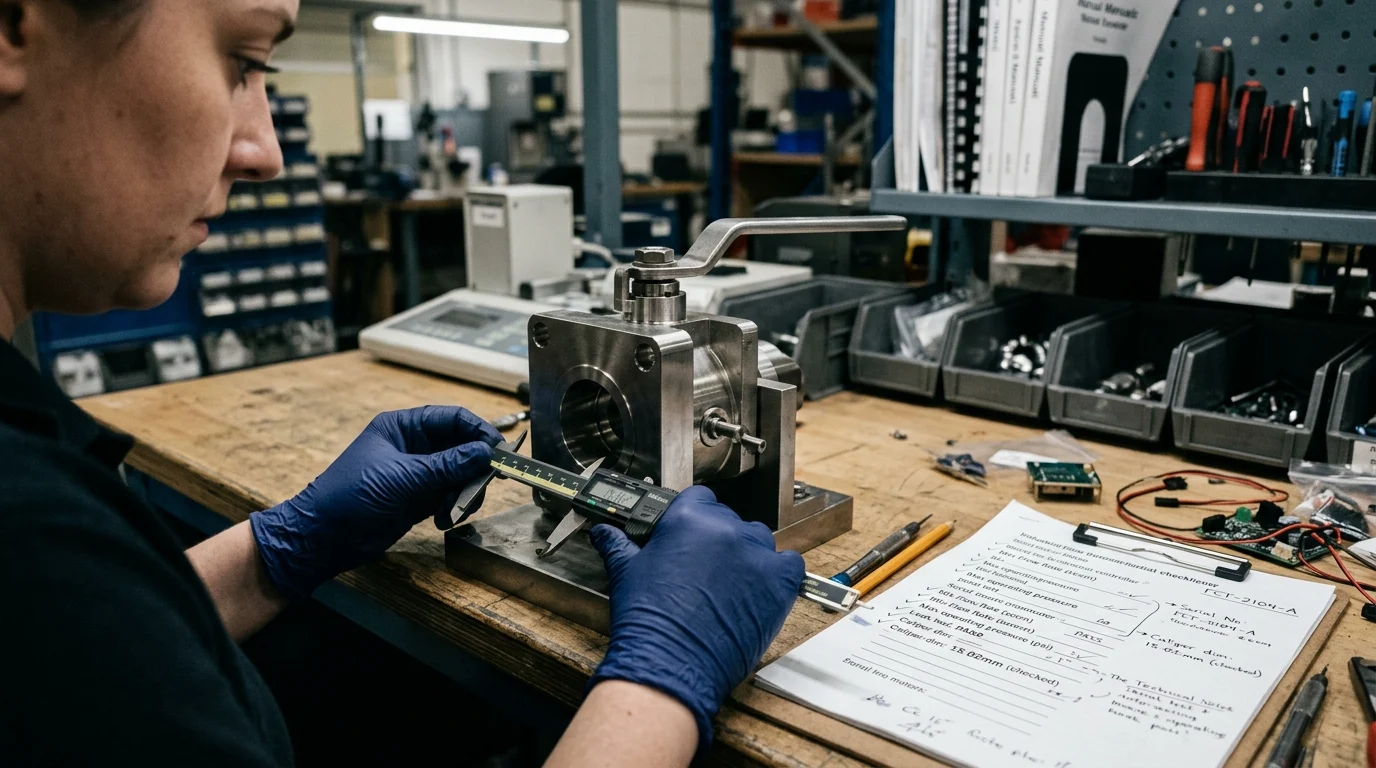
Transitioning from operational theory to concrete specification requires a rigorous analysis of the throttle’s technical capabilities. Procurement engineers must evaluate a matrix of fluid dynamics metrics to ensure the selected component aligns seamlessly with the intended application. This involves calculating precise flow coefficients and mapping the physical and chemical boundaries of the operating environment.
Cv, pressure range, turndown, and response time
The foundational metric for any flow controller is the flow coefficient (Cv), which quantifies the valve’s capacity to pass media at a specific pressure drop. Accurately sizing the Cv ensures the throttle neither starves the system of flow nor operates too close to its closed position, which can induce severe cavitation or excessive noise. Engineers must calculate the required Cv based on maximum and minimum anticipated flow rates, ensuring the valve operates optimally within the 20% to 80% range of its total stroke.
Equally critical are the pressure range, turndown ratio, and response time. Industrial throttles must safely manage maximum operating pressures (MOP) that frequently exceed 3,000 PSI in hydraulic applications, or sit comfortably within 100-150 PSI for standard pneumatics. The turndown ratio—the ratio of maximum to minimum controllable flow—often dictates the flexibility of the device, with high-performance proportional valves offering ratios of 50:1 or even 100:1. In automated systems, response time is paramount; advanced mass flow controllers are expected to achieve setpoint stabilization in under 50 milliseconds to support rapid-fire PLC commands.
Media compatibility, temperature limits, and sealing materials
Media compatibility dictates the longevity and safety of the flow controller. The wetted materials—typically brass, 316L stainless steel, or engineered polymers—must resist the corrosive or abrasive nature of the working fluid. In applications involving aggressive chemicals or high-purity gases, specifying the correct alloy prevents particulate shedding and structural degradation. For versatile connectivity in standard pneumatic lines, components like the SL-flow control female throttle offer standardized threading that simplifies integration while maintaining robust media containment.
Temperature limits and sealing materials form the next critical layer of specification. Standard NBR (Nitrile) seals are cost-effective for ambient air applications but degrade rapidly above 80°C. For extreme thermal environments or volatile media, engineered elastomers such as FKM (Viton), EPDM, or PTFE are mandatory, extending operational limits from cryogenic levels up to 250°C. Furthermore, high-vacuum or hazardous gas applications demand stringent leak integrity, often requiring helium leak testing to certify leakage rates below 1×10^-9 atm cc/sec.
Procurement comparison criteria
To streamline the procurement process, buyers should evaluate competing throttles across standardized technical criteria. The following table illustrates a typical comparison framework used by sourcing teams to differentiate between standard and high-performance flow controllers:
| Specification Criteria | Standard Pneumatic Throttle | High-Purity Gas Controller | Heavy-Duty Hydraulic Throttle |
|---|---|---|---|
| Typical Media | Compressed Air, Nitrogen | Argon, Helium, Silane | Hydraulic Oil, Water-Glycol |
| Pressure Range | 0 to 150 PSI (10 bar) | Vacuum to 3,000 PSI | 500 to 5,000+ PSI |
| Body Material | Nickel-Plated Brass, PBT | 316L Var/Elgiloy | Carbon Steel, 316 SS |
| Seal Material | NBR (Nitrile) | Metal-to-Metal, FFKM | FKM, Polyurethane |
| Response Time | 100 – 200 ms | < 50 ms | 200 – 500 ms |
| Turndown Ratio | 10:1 | 50:1 to 100:1 | 20:1 |
By demanding transparent datasheets that address these specific metrics, procurement professionals can eliminate technically deficient options early in the sourcing cycle.
Comparing Flow Controller Throttle Designs and Applications
The physical architecture of a flow controller throttle determines its suitability for specific industrial tasks. B2B buyers must navigate a diverse marketplace of valve designs, each engineered to address unique challenges related to pressure dynamics, media states, and control mechanisms. Selecting the correct design architecture is a prerequisite for long-term mechanical reliability.
Needle, proportional, high-pressure, and corrosion-resistant designs
Needle valves represent the most traditional throttle design, utilizing a finely threaded, tapered plunger to provide granular, manual control over low-flow rates. They are highly reliable but lack automation capabilities. Conversely, proportional flow controllers utilize electromagnetic solenoids or piezoelectric actuators to dynamically adjust the orifice size based on real-time analog signals (e.g., 4-20mA or 0-10V). This allows for seamless integration into closed-loop control systems requiring continuous flow modulation.
For specialized environments, high-pressure and corrosion-resistant designs are necessary. High-pressure variants feature reinforced bodies and specialized stem packing to withstand intense mechanical stress without yielding. Corrosion-resistant models, often machined from Monel, Hastelloy, or PTFE, are deployed in chemical processing where standard steels would fail. Additionally, rapid-assembly designs are favored in modular automation; for instance, the SLG- flow control push on throttle enables instantaneous, secure tubing connections, drastically reducing installation time in dense pneumatic panels.
Maintenance, calibration, and contamination risks
Regardless of the design, all flow controllers are susceptible to operational degradation over time. Contamination is the leading cause of throttle failure. Particulates as small as 5 microns can score the valve seat or clog the control orifice, leading to internal leakage and loss of flow resolution. Implementing appropriate upstream filtration (typically 5 to 40 microns, depending on the valve’s internal clearances) is a mandatory preventative measure.
Maintenance schedules and calibration intervals must be factored into the selection process. Advanced digital mass flow controllers may experience zero-drift over time, typically requiring recalibration every 12 to 18 months to maintain their stated accuracy of <0.5% full scale. Mechanical throttles, while less reliant on electronic calibration, require periodic seal replacements and stem lubrication. Buyers should prioritize designs that quote a Mean Time Between Failures (MTBF) exceeding 2 million cycles for standard pneumatic applications, ensuring adequate longevity before major overhauls are required.
Sector-specific application requirements
Different industrial sectors impose distinct regulatory and operational demands on flow control hardware. The table below outlines how specific application environments dictate the choice of throttle technology and their associated performance benchmarks:
| Industrial Sector | Preferred Throttle Design | Critical Application Focus | Baseline MTBF Expectation |
|---|---|---|---|
| Semiconductor / Microelectronics | Piezoelectric Mass Flow | Ultra-high purity, zero particle generation | > 3 Million Cycles |
| Medical & Biopharma | Pinch Valves, Proportional | Sanitary washdown, low shear stress | > 1.5 Million Cycles |
| Pneumatic Automation | Push-to-Connect Throttles | High cycle rates, rapid installation | > 5 Million Cycles |
| Heavy Machinery | Compression / Needle | Vibration resistance, high pressure | > 1 Million Cycles |
For heavy machinery and ruggedized equipment, vibration-resistant connections are paramount. Utilizing components like the SL- compression throttle ensures that mechanical shocks do not compromise the integrity of the fluid circuit, maintaining a secure seal even under continuous dynamic loading.
Sourcing, Quality Assurance, and Compliance Checks
Technical suitability is only half the equation; securing a reliable supply chain is equally vital. B2B buyers must rigorously vet potential flow controller throttle manufacturers to ensure consistent product quality, regulatory compliance, and scalable production capacity. A robust Quality Assurance (QA) framework at the supplier level prevents costly defects from infiltrating the buyer’s operations.
Supplier capability and manufacturing quality
Assessing supplier capability begins with an audit of their manufacturing infrastructure. High-quality flow controllers require exceptional machining precision, often necessitating CNC tolerances tighter than +/- 0.005 mm to ensure perfect mating between the valve needle and seat. Buyers should investigate the supplier’s investment in automated inspection equipment, such as Coordinate Measuring Machines (CMM) and optical comparators, which verify dimensional accuracy at scale.
Furthermore, the assembly environment plays a critical role in product reliability. For throttles destined for medical, food-grade, or semiconductor applications, suppliers must utilize certified cleanrooms (typically ISO Class 6 or 7) to prevent ambient dust and hydrocarbons from contaminating the internal components during assembly. A supplier’s ability to demonstrate statistical process control (SPC) with defect rates consistently below 500 Parts Per Million (PPM) is a strong indicator of manufacturing maturity.
Certifications, compliance, and documentation
Regulatory compliance and comprehensive documentation are non-negotiable in modern industrial procurement. At a minimum, the manufacturing facility should hold an active ISO 9001 certification. Depending on the target market, the throttles themselves may require specific compliance marks, such as CE for the European Economic Area, or RoHS and REACH certifications to guarantee the absence of hazardous substances in the materials and platings.
For critical applications, buyers must mandate strict traceability documentation. This includes Material Test Reports (MTRs) conforming to EN 10204 3.1, which certify the chemical and physical properties of the raw metals used in the valve body. In explosive or hazardous environments, ATEX or IECEx certifications are legally required to ensure the electrical components of proportional throttles will not ignite ambient gases. The absence of these documents introduces severe legal and operational liabilities.
Qualification and sample validation steps
Before committing to a high-volume purchase agreement, procurement teams must execute a stringent qualification and sample validation protocol. This process initiates with a First Article Inspection (FAI), where an initial production run of 10 to 50 units is meticulously evaluated against the engineering drawings to verify dimensional and functional compliance.
Following FAI, the samples undergo accelerated life testing within the buyer’s proprietary systems. This often involves subjecting the throttles to 100,000 to 500,000 rapid actuation cycles at maximum rated pressure and elevated temperatures to induce premature wear. Engineers monitor the units for seal degradation, flow coefficient drift, and external leakage. Only after the samples successfully pass these empirical validation steps should the buyer authorize full-scale serial production.
Final Buying Decision for a Flow Controller Throttle

The culmination of technical analysis, design comparison, and supplier vetting is the final purchasing decision. Establishing a standardized procurement methodology ensures that all variables are accounted for, mitigating risks and aligning the flow controller throttle acquisition with the organization’s broader financial and operational objectives.
Step-by-step selection process
A systematic step-by-step selection process is the most effective defense against specification errors. The process begins with absolute clarity on the application parameters: defining the media, calculating the required Cv, and establishing the minimum and maximum operating pressures and temperatures. Next, engineers must select the appropriate materials for the valve body and seals to ensure chemical compatibility and thermal resilience.
Once the technical baseline is established, the focus shifts to control requirements. Buyers must decide between manual, pneumatic, or electronic actuation based on the system’s automation architecture. This is followed by shortlisting 3 to 4 pre-qualified suppliers who meet the necessary ISO and industry-specific certification standards. Finally, cross-referencing quote packages against the Total Cost of Ownership—factoring in unit price, expected MTBF, and energy efficiency—will reveal the most economically advantageous tender.
Commercial terms, inventory, and spare parts
Negotiating favorable commercial terms is the final hurdle. Buyers must evaluate the supplier’s lead times, which can range from a standard 2 to 4 weeks for off-the-shelf pneumatic throttles, to 12 to 16 weeks for custom-machined exotic alloy controllers. Minimum Order Quantities (MOQs) also play a critical role; standard components may have MOQs of 100 units, while bespoke designs might require commitments of 500 units or more to offset custom tooling costs.
Finally, a robust inventory and spare parts strategy must be codified in the purchase agreement. Given the critical nature of flow controllers, facilities should maintain a strategic reserve of spare units—typically 10% to 15% of the active installed base. Securing guaranteed pricing for replacement seal kits, solenoid coils, and full assembly backups ensures that maintenance teams can respond instantly to unexpected failures, thereby safeguarding the facility’s continuous operational uptime.
Key Takeaways
- The most important conclusions and rationale for Flow Controller Throttle
- Specs, compliance, and risk checks worth validating before you commit
- Practical next steps and caveats readers can apply immediately
Frequently Asked Questions
How do I choose the right Cv for a flow controller throttle?
Size Cv from your required flow and pressure drop, then keep normal operation around 20%–80% of valve stroke for stable control and lower wear.
What pressure range should a pneumatic flow controller throttle handle?
Match the unit to your actual line pressure plus a safety margin. For standard pneumatics, many systems run near 100–150 PSI, but always verify peak conditions.
Why is media compatibility important when selecting a throttle?
The wrong body or seal material can corrode, swell, or leak. Confirm compatibility with your gas or fluid, temperature range, and any aggressive additives before ordering.
When should I prioritize response time and turndown ratio?
Prioritize both in fast automated lines or variable-flow processes. Quick response improves cycle consistency, while a higher turndown ratio maintains control across wider operating ranges.
Can NHPC help match a flow controller throttle to my application?
Yes. Share your medium, pressure, flow range, port size, temperature, and control method, and NHPC can recommend a suitable flow controller throttle for your system.